 Earkeep
Your agents, right where your meetings are
Earkeep runs the agents you already use inside the app, against your local meeting history, and ships an MCP server so the tools outside it can read your meetings too. Your meeting knowledge and your AI tooling stop living in two different places.


The problem: your meetings and your agents live in two different worlds
You already run agents. Maybe it's Claude Code for a coding task, maybe it's a knowledge agent you point at project docs. Those agents are good at drafting, summarizing, and pulling structure out of text, but they don't know what happened in this afternoon's call, because that transcript is sitting in a notetaker's cloud dashboard, not anywhere your agent can reach it.
Cloud notetakers try to close that gap from their end. Most now ship their own built-in assistant, and several expose an MCP server or an API you can point your own agent at, so it isn't that your meetings are unreachable. It's that they're somewhere else: you finish the call, switch to another app, wait for the transcript to land in the vendor's cloud, and connect an agent to it from outside. The work happens away from the meeting, which is exactly when you have the least appetite for it.
Earkeep starts from the other end: your meeting history is a local resource, and any agent you choose to run can be pointed at it. Run one inside Earkeep and you go from "the call just ended" to a drafted artifact without leaving the app or uploading anything. Prefer your agent where it already lives? Earkeep's own MCP server hands the same meetings to it from outside, so the choice is yours, not the vendor's.
It also means you don't pay twice for the same intelligence. The agent you point at a meeting is your agent, on the plan you already have with it, and Earkeep neither resells model access nor charges a per-meeting AI fee on top. That's what lets it be a one-time €39 license, not a subscription: what makes this category recurring is somebody else's inference bill, and here there isn't one to pass on to you.
Supported ACP agents
Ten agents run inside Earkeep today, with nothing to set up beyond picking one: Claude Code, Codex, Cursor Agent, Gemini CLI, Hermes, Kimi CLI, OpenClaw, opencode, Pi, and Qwen Code, the same ten whose marks sit at the top of this page.
Because what Earkeep integrates with is the protocol, not ten separate agents, any other agent that speaks ACP works the same way, including ones that don't exist yet.
How it works
In-app agents via ACP. Earkeep speaks the Agent Client Protocol, so an agent runs inside Earkeep itself, with your local transcripts as its context and its whole session kept beside the meeting it was about. Which agents, in the section above.
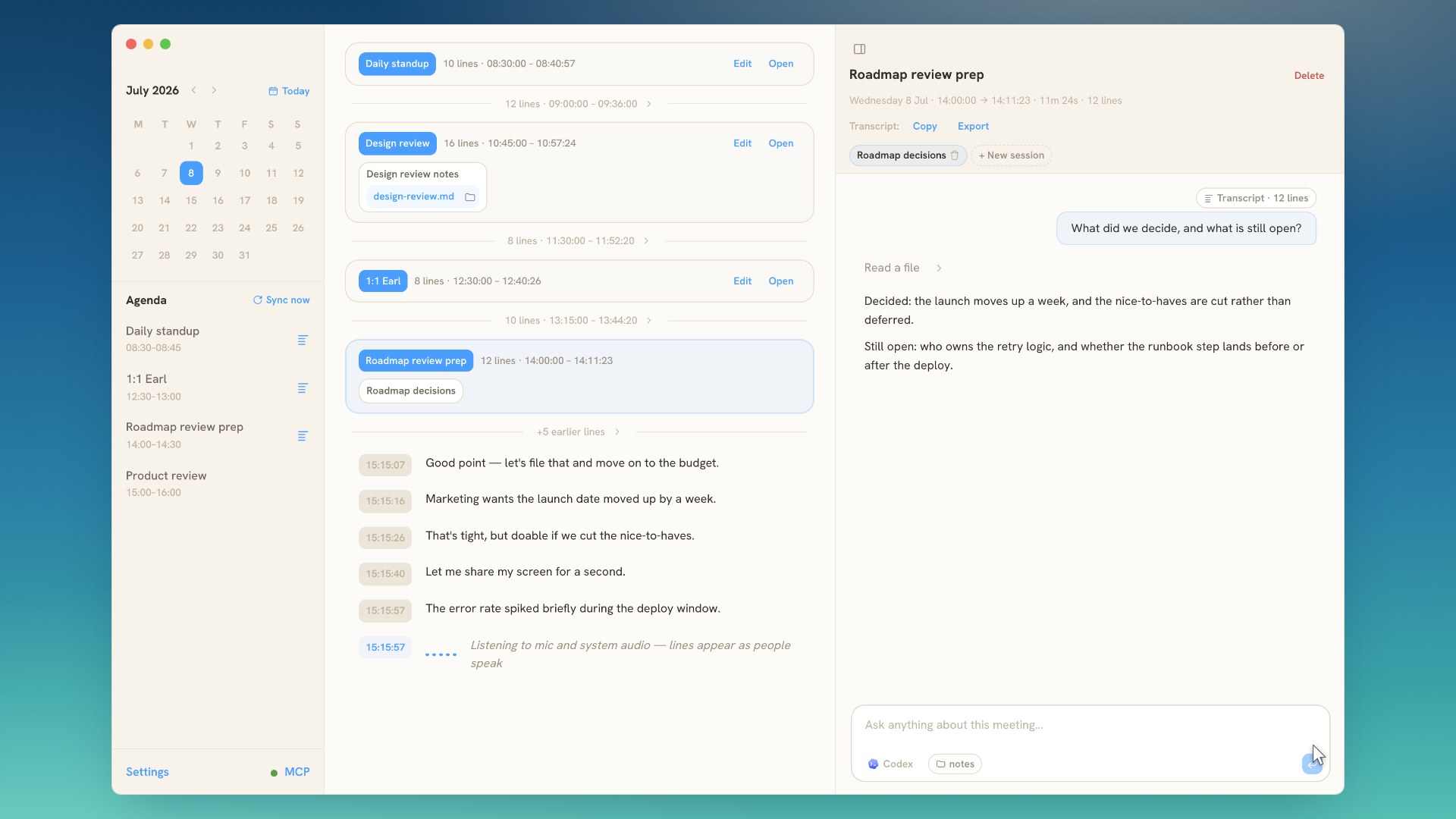
A built-in MCP server for everything else. Earkeep also runs an MCP (Model Context Protocol) server, so tools that aren't ACP agents, like Claude Desktop or Cursor, can connect and read your meeting history the same way they'd connect to any other MCP data source. You don't have to run your agent inside Earkeep to use your meetings with it.
Or no protocol at all. Your transcripts are plain files you own, sitting in a folder you picked. Anything that can open a text file can read them, so a tool that speaks neither ACP nor MCP still doesn't need an integration built for it.
What this looks like in practice
A summary is the least interesting thing an agent can do with a meeting. What runs inside Earkeep is a working agent with your own tools attached, so the output can be the artifact the meeting was supposed to produce, made while the call is still fresh:
- The follow-up email, or the notes themselves, written from what was actually said instead of from what you remember an hour later.
- A spec or PRD draft out of a discovery call, with the requirements someone stated out loud already in it. For product managers →
- Backlog items with acceptance criteria from a refinement session, worded the way the team agreed, not the way you paraphrased it afterwards. For product owners →
- A working prototype of what the room just described. A coding agent that can read the critique can also build the screen it asked for. For UX designers →
- Findings with the quotes still attached, grouped across a week of interviews instead of one session at a time. For UX researchers →
- A status report, or the list of what was promised, gathered across every call where the project came up. For project managers →
- What you agreed with someone over a quarter of 1:1s, so the record is the record and not your memory of it. For people managers →
- The decision trail from a run of incident calls and design reviews, so being the person who remembers stops being part of the job. For engineering leads →
- A report that joins what was said to your own data, if the agent you run has connectors to the systems holding it. A meeting becomes one more source it can read, beside the database and the repo.
Does this keep everything local?
Earkeep's part stays local: your transcripts are plain files on your disk, and Earkeep hands them to an agent or MCP client without uploading anything itself. What happens after that depends on the agent you chose. Some agents run fully on-device; many, including most of the ones listed above, call their own model provider's API as part of how they work. That's a property of the agent you picked, not of Earkeep, so if keeping meeting content off any network matters to you, it's worth checking how your chosen agent handles the context you give it.
Related
- Private by design: the audio-never-leaves-the-device mechanism this page's agent access sits on top of, and why transcripts are plain files anything can read.
- Always-on capture: how spans turn into the transcript history your agents read.
- Local RAG: the practical guide to querying a local corpus with a local model.
Frequently asked questions
What is ACP?
The Agent Client Protocol, a way for an agent to run inside a host application, like Earkeep, with access to that application's context. It's what lets Claude Code, Gemini CLI, and the other listed agents run inside Earkeep against your meeting history instead of in a separate terminal with no idea a meeting happened.
What is MCP?
The Model Context Protocol, a way for external tools to connect to a data source and read from it. Earkeep's built-in MCP server exposes your meeting history to any MCP-capable client, so tools like Claude Desktop or Cursor can read your meetings without needing to run inside Earkeep at all.
Do I need an account to use agents with Earkeep?
No. Earkeep itself needs no account, no cloud, and no API keys. Whether an individual agent needs its own account or API key depends on that agent, not on Earkeep.
Which agents are supported?
Claude Code, Codex, Cursor Agent, Gemini CLI, Hermes, Kimi CLI, OpenClaw, opencode, Pi, and Qwen Code run inside Earkeep today via ACP, and any other ACP-compatible agent works the same way. Anything MCP-capable, like Claude Desktop or Cursor, can connect through Earkeep's MCP server.
Can my company's internal tools connect?
Any tool that speaks MCP can connect to Earkeep's MCP server the way it would connect to any other MCP data source, and Earkeep tells you how: its Connect apps panel shows the server's address and the exact copy-paste setup for Claude Code, Claude Desktop, Codex (CLI and IDE), and Cursor, so connecting one is usually a single command you copy out of the app, not something to go and look up. Beyond MCP, because transcripts are plain files, an internal script can read them directly without going through a protocol at all.
Bring your own agent
14-day full trial, no account required.