 Earkeep
Always-on capture, meetings marked after the fact
Earkeep records mic and system audio continuously while it's running, transcribes what it hears locally on your computer, and lets you mark which stretch of the day was a meeting once it is already over. There is no record button. There is no bot that joins your call. You never have to remember to start anything, because Earkeep already did.
The problem: hitting record is a bet you place too early
Every meeting-heavy week has the same failure mode. Someone says the one sentence that matters twenty minutes into a call nobody thought to record. A quick huddle turns into a real decision, but there's no bot to invite because it's not scheduled in your calendar. You open a notetaker at the top of the meeting, but you were three minutes late, or you forgot entirely, because remembering to hit record is one more thing competing with the actual work of paying attention.
Those are one problem wearing different clothes: recording is a prediction. You have to decide, before the conversation has said anything, whether it's going to matter enough to capture. Most meetings don't announce that up front, and by the time you remember you should have hit record, the thing that mattered has already been said.
Bots make it worse in their own way. They announce themselves in the participant list, they need to be invited, and they only work on the video calls that thought to add them. None of that helps with the meeting that happened at your desk with a colleague who dropped by, or the one that started before you realized it was a meeting at all.
The fix isn't a better reminder to record. It's not needing to decide in advance at all.
How it works
Continuous capture, while Earkeep is running. Earkeep records from your microphone and your system audio at the same time, so it hears both sides of a call and anyone speaking in the room. It runs the whole time the app is open, not just inside a session you started.
Transcription happens locally, as audio comes in. Speech is transcribed on-device with Whisper or Parakeet models, hardware-accelerated on Apple Silicon. Nothing is sent anywhere to be transcribed.
The day is a timeline. Everything Earkeep has transcribed sits on a single timeline you can scan and zoom into, with a minimap for orienting across a full day.
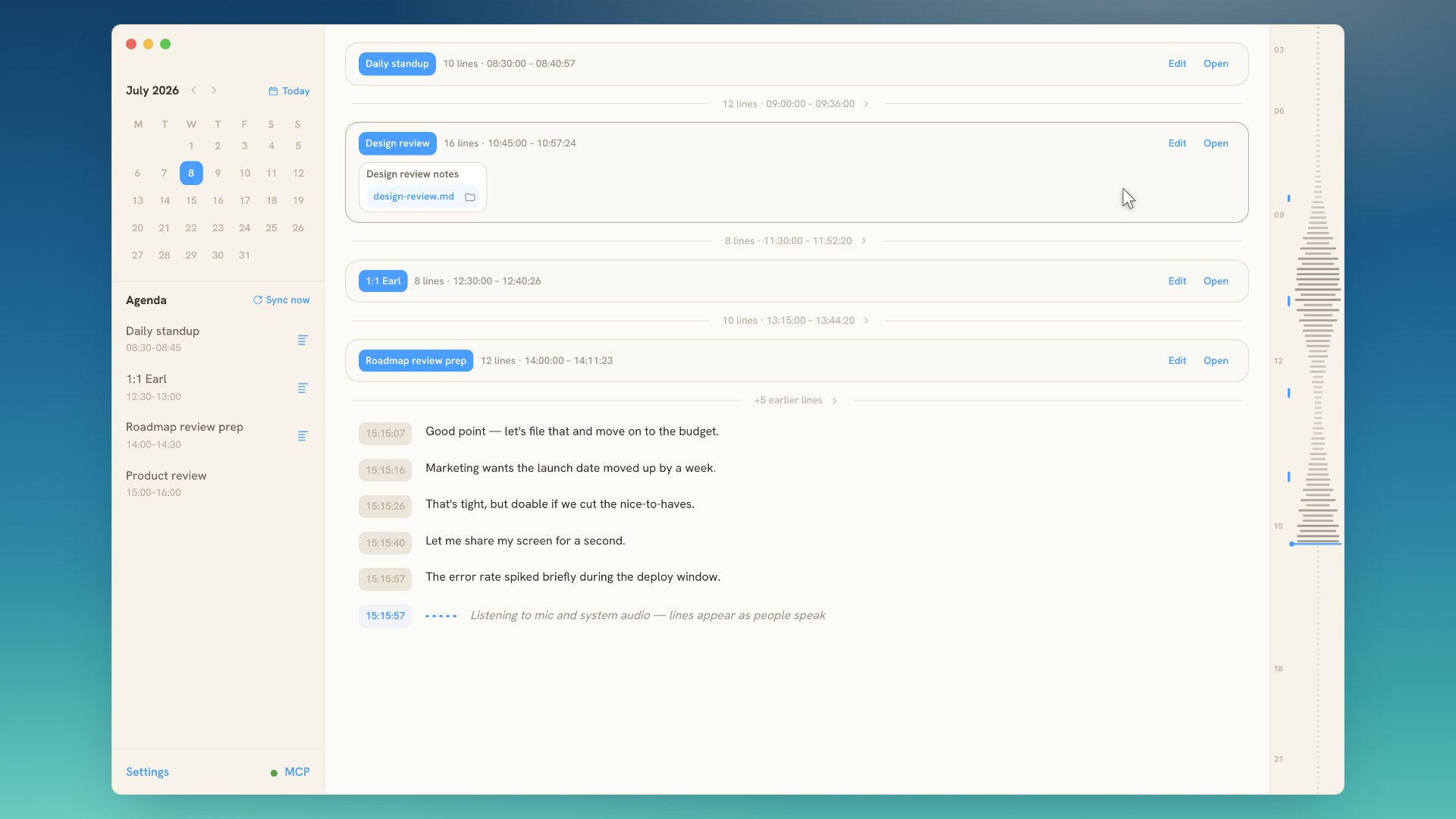
A meeting is a span you select, retroactively. When you want to keep a meeting, you drag across the stretch of the timeline it covers, right after it ends or hours later once you realize it mattered. That selection becomes a saved meeting: its own transcript, separate from the rest of the day, that you can open, search, and hand to an agent. There's no start/stop moment to get right, because the transcript was already there waiting.
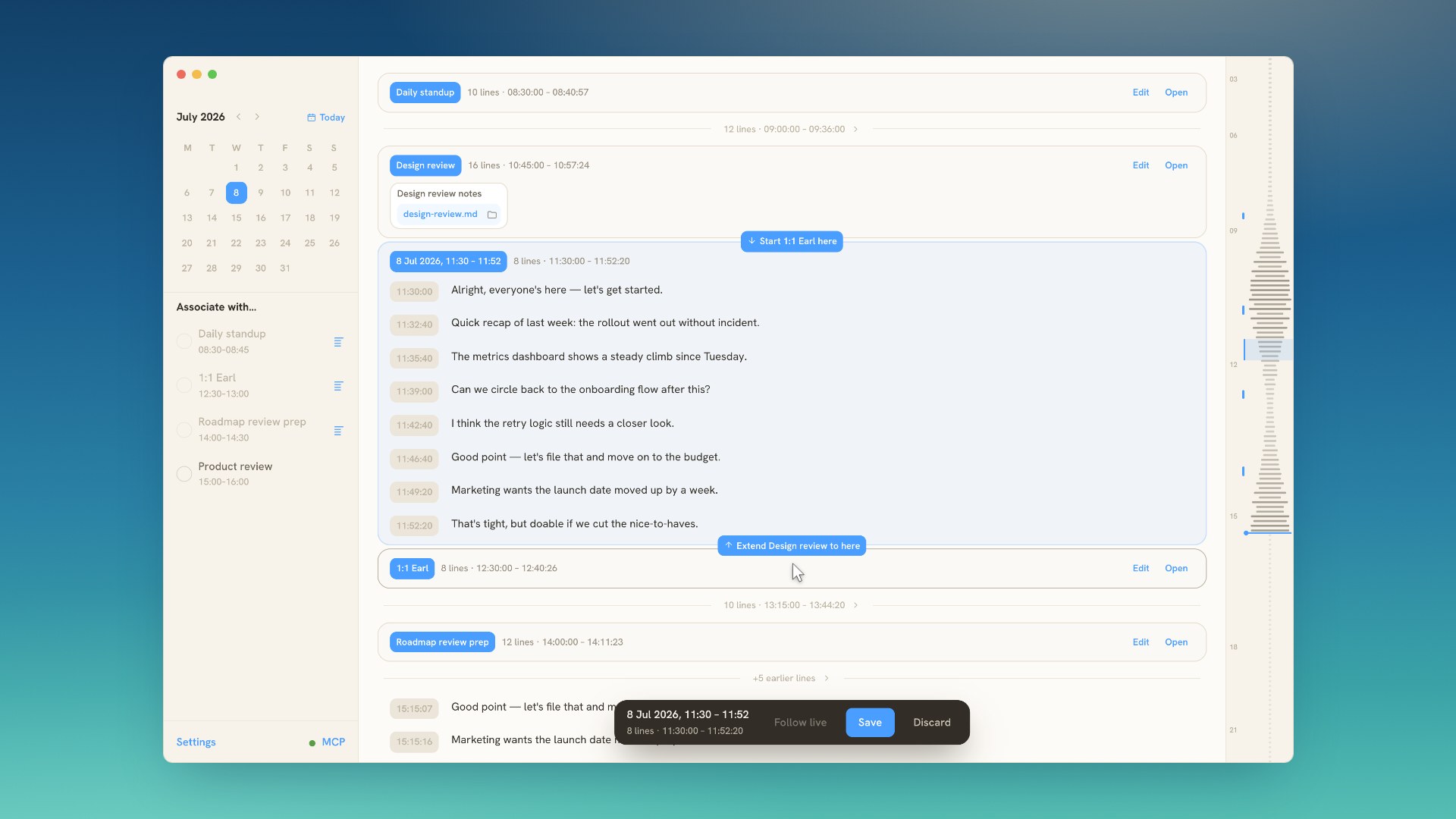
Or your calendar does the selecting. Connect a calendar and each event becomes a span on its own, titled from the agenda, with no dragging required. That's the zero-touch version of all this: you don't even mark the span, because your calendar already told Earkeep where the meeting was. See calendar connection for the four sources Earkeep reads and how automatic spans behave.
Either way, in-person meetings work the same as online ones: as long as your laptop is open and Earkeep is running, it hears the room. There's no platform to join and no call to be a participant in.
Won't listening all day drain my battery?
No.
Earkeep's audio pipeline uses voice-activity detection to filter out silence and background noise, so transcription only runs when someone is actually speaking. It uses the same local Whisper and Parakeet models that power other local transcription apps, so keeping an ear to the ground all day costs no more battery than actually transcribing the speech that happens in it.
Is Earkeep recording audio to disk, or sending it over the network?
Neither.
Audio is processed only in memory as it's transcribed, and it is never written to disk: no recording file, no temp .wav, nothing in a cache folder. It is never uploaded either, because transcription runs on your own machine and has no server or API to send anything to. What gets saved is the transcript itself, as plain text files you own. See private by design for the full mechanism, including why this matters against transcription tools that upload your audio to a third-party API.
What if someone doesn't want to be recorded?
Then you stop, and you can show that you stopped.
Always-on is the default because remembering to record is the thing that fails. It is not a trap. There are three ways to stop, and each one is meant to be used in front of the person who asked.
Pause, from the live edge of the transcript. Fifteen minutes, thirty, an hour, or until you resume. Pausing releases the microphone and the system audio stream, so your operating system's own recording indicator goes dark. That is the point of doing it that way: the person across the table can see the light go out instead of taking your word for it. A timed pause starts recording again by itself.
Mark a meeting as never-record. Any event on your connected calendar can be struck from the agenda, and Earkeep stops capturing for the length of it and starts again when it ends. Useful for the standing 1:1 that should never be transcribed, so you don't have to remember on the day.
Delete what was already said. Select a stretch of the day and purge it, delete a saved meeting together with its transcript, or remove a whole day. The lines go out of the file and nothing takes their place.
Both stopping and deleting leave no trace, on purpose. A paused stretch and a purged stretch read afterwards exactly like a stretch where nobody spoke: no gap marker, no "paused here" row, nothing to explain to anyone later. The cost of that is real and worth stating plainly, because it cuts both ways: looking at an old day, you cannot tell a pause from a silence.
None of this makes a recording lawful. Earkeep announces itself to nobody, so telling people is yours to do. What to say, and when you have to say it covers what the rules generally ask for and where they differ.
Related
- Calendar connection: let events start and end your meetings, with nothing to drag.
- Private by design: why audio never leaves your computer, and why transcripts are plain files you own.
- For product managers: catching verbal commitments in stakeholder and customer calls without hitting record.
- For engineering leads: capturing the huddles and clarifications that never get a calendar invite.
- For people managers: why 1:1 notes can look like an eidetic memory.
Frequently asked questions
Does always-on capture drain my battery or spike my CPU?
No more than transcribing the speech that actually happens. The voice-activity-detection pipeline only runs transcription when someone is speaking, using the same local models as other local transcription apps, so an idle stretch of your day costs almost nothing.
What if Earkeep wasn't running when the meeting happened?
Earkeep can only transcribe audio while it's running, so a meeting that happened while the app was quit isn't in the transcript. You don't have to keep its window open, though: Earkeep lives in the menu bar, so it can listen through the whole day with nothing on screen at all.
Can I exclude a sensitive stretch of time?
Yes, before or after. Pause from the live edge for as long as you need, or mark the calendar event as never-record so capture stops for its whole length without you remembering on the day. Pausing releases the microphone, so the recording indicator goes dark while it lasts.
Afterwards, select the stretch and purge it. The lines are removed from the file and nothing is kept in their place, and because the transcript is a plain text file on your own disk there's no server copy to reconcile it against.
Does pausing actually stop the microphone, or just throw the audio away?
It stops the microphone. Earkeep releases the input device and the system audio stream, which is what makes your operating system's recording indicator go dark. An app that merely discarded the audio would look identical inside Earkeep and prove nothing to the person who asked you to stop.
If I pause, can anyone tell later that I paused?
No, and that's deliberate. A paused stretch looks exactly like a stretch where nobody spoke, because nothing is written to mark it. The same is true of anything you purge. It means nobody reading the transcript later can see that a gap was chosen rather than quiet, and it also means you cannot tell the two apart yourself.
What if a meeting ran over its calendar slot?
The underlying transcript is continuous regardless of what your calendar said, so nothing outside the scheduled slot is lost. Drag the span's edge out to where the conversation actually ended. It works in the other direction too: if people were already talking ten minutes before the invite began, that stretch was recorded as well, so pull the opening edge back and keep it.
What about back-to-back meetings with no gap between them?
Because capture is continuous, there's no dead time between meetings for Earkeep to miss. Each meeting is still its own span, selected separately or defined by its own calendar event, so back-to-back calls become separate kept meetings, not one blurred transcript.
Do I have to connect a calendar to use spans?
No. A calendar connection is a convenience that removes the last manual step; without one, you select spans on the timeline yourself. Both paths produce the same kind of kept meeting.
Does a bot join my video calls?
No. Earkeep captures system audio directly from your computer, so there's nothing to invite, nothing in the participant list, and nothing for the other people on the call to notice.
Does this work for in-person meetings?
Yes. Earkeep captures your microphone the same way whether the conversation is happening over a video call or across the table, as long as your laptop is open and Earkeep is running. There's no platform to join, so a meeting that happens across a table is captured exactly like one that happens on a screen.
What about hybrid meetings, with some people in the room and some online?
Both halves land in the same transcript, because Earkeep captures two sources at once. The people on the call arrive through your system audio, exactly as they would on a fully remote call, and the people in the room arrive through your microphone. It makes no difference which side of the hybrid you're sitting on.
Stop losing what was said
14-day full trial, no account required.